Dense Array Toolkit
Overview
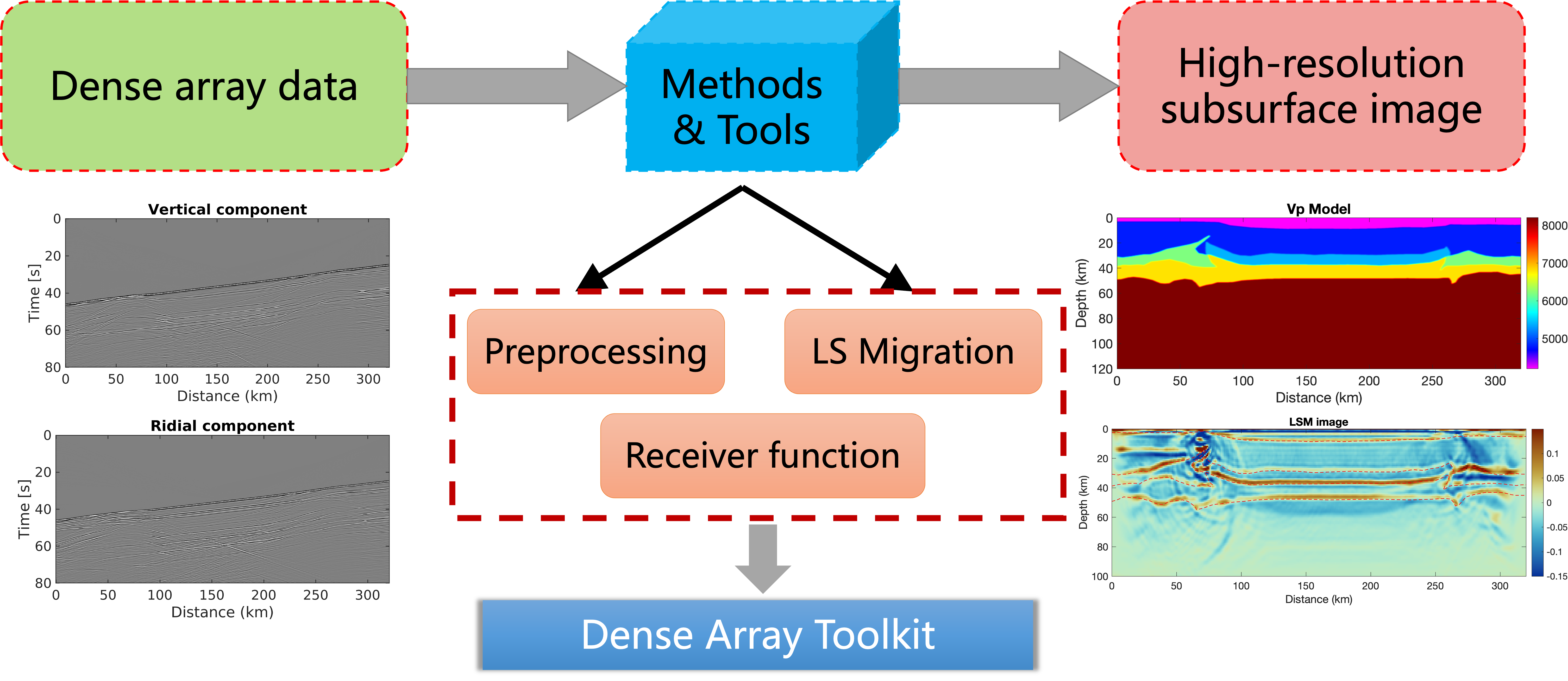
Dense array toolkit (DAT) is an open-source, MATLAB-based software package for dense seismic array data processing and imaging. Motivated by the increasing deployment of large-N seismic arrays and the growing demand for advanced data analysis tools, DAT provides a comprehensive framework that integrates receiver function calculation, data processing techniques (such as radon transform, and rank-reduction methods), and advanced imaging algorithms including common conversion point stacking, migration, and least-squares migration.
Objects
DAT is designed for efficient processing of large volumes of short-period nodal seismic data, with three key modules:
rapid receiver function calculation
advanced array-based data processing
improved subsurface structure imaging
Features
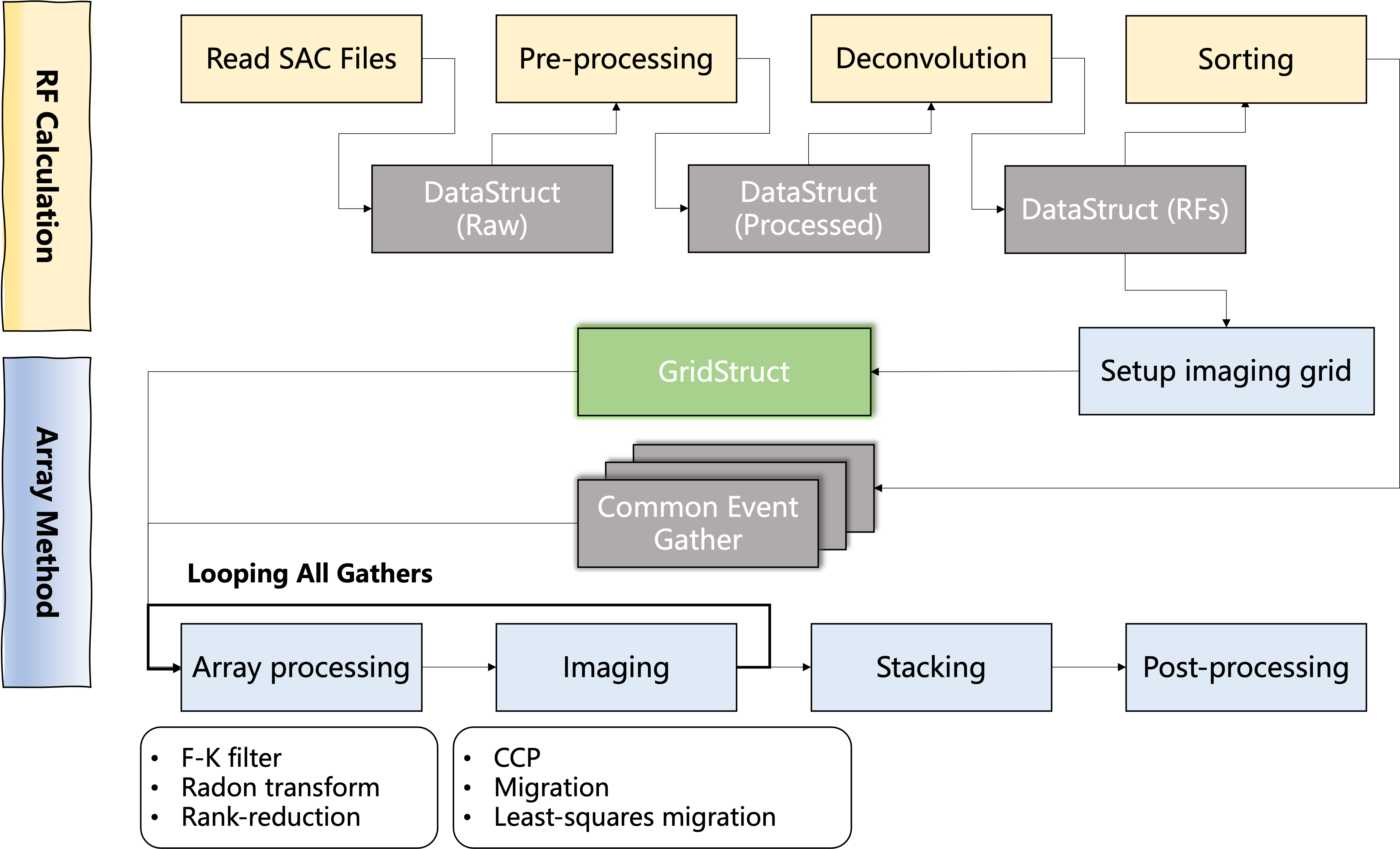
The software comprises three key struct variables:
DataStruct: Stores essential seismic data information, including fields such as Waveforms, TimeAxis, StationInfo, EventInfo, Header, RF, TravelInfo, and ProcHistory.
GridStruct: Defines the spatial grid configuration of the array. Station coordinates are projected onto a Cartesian coordinate system aligned with the principal and secondary axes.
ParamStruct: Contains parameters for data preprocessing, such as filtering, normalization, and time window selection.
Quickstart
The software is entirely written in MATLAB, and can be easily installed and used on Windows, Linux, and macOS. MATLAB R2021a or later is recommended.
The following is a quickstart guide to get you started.
Download the source code:
Clone the DAT repository (DAT-public branch) from GitHub:
git clone -b DAT-public git@github.com:PengfeiZuo001/DenseArrayToolkit.git DenseArrayToolkit-public
Or download the source code from here.
Run
setupPaths.minDenseArrayToolkit-public/directory to setup the path:
Run the demo:
Change directory to
DenseArrayToolkit-public/demo/directory.Run
demo_Stacking.mto perform the stacking demo.Run
demo_rankReduction.mto perform the rank reduction demo.Run
demo_Migration_2D.mto perform the 2D LSM demo.Run
demo_Migration_3D.mto perform the 3D LSM demo.
Explore Documentation (Coming soon):
To be updated.
How to cite
If you use DAT in your research, please cite it as follows:
Chen, Y., Gu, Y. J., Zuo, P., Zhang, Q., Wang, H., & Chen, Y. (2025). Least-squares migration imaging of receiver functions. IEEE Transactions on Geoscience and Remote Sensing. PDF
Contributing
We welcome contributions!
Feel free to contact with us if you have good ideas and suggestions.